Interview By Deniz Hakman
Interview with Lyra Pramuk
By Deniz Hakman
Lyra Pramuk speaks to an indelible truth: music is inseparable from life itself. It is clear that the Berlin-based vocalist, producer, composer, astrologer, storyteller has spent a great deal of time contemplating a musical past, allowing musings on folk spirit, community, and collective ritual to guide her music-making in the present and suffuse her dreams for music’s future. Her newest record, Hymnal, is a spiritual testimony that looks beyond the customary frameworks and toward something more cosmic, calling out through layered vocals and looping strings to ask us if it’s possible to reclaim the spirit we lost along the way.
Ahead of her performance of Hymnal for FIBER x The Rest is Noise on January 10th, we spoke with Lyra about her approach to music, building courage, and the importance of slowing down, especially when things feel ever-accelerating.
You have frequently mentioned “Folk” being an inspiration to your work. In what ways does that relationship to folk emerge in Hymnal?
Folk is not really interesting to me as a genre marker as much as it is a marker of music as a form of political communal power. “Folk music” was always about groups of people, cultural lineage, and storytelling. Colonial capitalism separated music from human culture. So, “Folk” is actually reclaiming the vital integral place of music in human society to correct this colonial error, and to say “Folk is most of the history of human music”. That is the foundation of this record for me. It is more important for me to try to be a good person in community with other human beings than to get rich off of music. It can be hard to do that because things move so fast in this industry. I have to make sure I am going slow enough that I can take care of the people I work with.
I have to believe primarily in the message of bringing new perspectives, a sense of healing, or something different into the culture.
Do you struggle with having to take part in the same industry you are criticizing? How do you reconcile having to market and promote yourself as a solo artist in that?
I have to believe primarily in the message of bringing new perspectives, a sense of healing, or something different into the culture. If I stay focused on my spiritual mission: music as a sacred mode of transmission and healing, then those promotional tools are just ways to communicate that message and make sure I have enough resources to pay my rent, bills, fund my work, and take care of the people I work with. That’s it. It’s just a tool.

You have described your music as devotional. Was there a moment when you decided to explore that idea, or did it come about naturally?
I think it grew organically from my last record, Fountain, which felt more personal. I was trying to cultivate a sense of unity in myself. Then my perspective broadened, and I realized I have to try to cultivate a sense of unity among a group of collaborators. It wasn’t easy because I can be very introverted and private. But I grew a lot and my philosophy grew too. I see how we are all connected to the universe and nature fundamentally. We are part of a choreography. There is no written rule that things have to be dysfunctional. I feel like we have the potential to live beautifully, even if there is violence throughout history.
This particular moment in time also feels extremely hegemonic and cynical. A lot of people have forcefully experienced a severance from nature and ritual. Hearing your thoughts, I think you’ve done a good job at finding hope and combating that cynicism. Do you have any advice for others on how to find that?
Psychedelics helped me a lot. Music, too. Music that cultivates a sense of harmony. Because this capitalist world we live in is so brutal, it has become commonplace for people to listen to music that is discordant. Don’t get me wrong, I love noise and heavy electronic music, but there are forms that pull your soul in a way that is cathartic, that generates something in you. That is what I mean by harmonious. It actually harmonizes you with your surroundings, even if it is noisy.
The current attitude people have toward music makes it hard to imagine what the experience of music like was pre capitalism.
I think that’s because consumer culture is so isolating. It’s less possible in this industry to have “We moments”. The marketplace fragments people’s ability to enjoy music together. We used to have religious rituals, but now that many aren’t religious, you don’t have these communal rituals anymore. A lot of great famous musicians in the past were beloved because they connected people to themselves. I just had a video come out for Pitchfork talking about Umm Kulthum. I’ve been researching her a bit more in the last days, just because it started some conversations with other people. She sacrifices a lot of herself to be a conduit for the audience. She’s channelling something for a whole community. It’s about communal national identity, longing, and connection. That is quite different from the modern pop style structure.
It’s less possible in this industry to have “We moments”. The marketplace fragments people’s ability to enjoy music together.
How did you try to channel that in the live show for Hymnal?
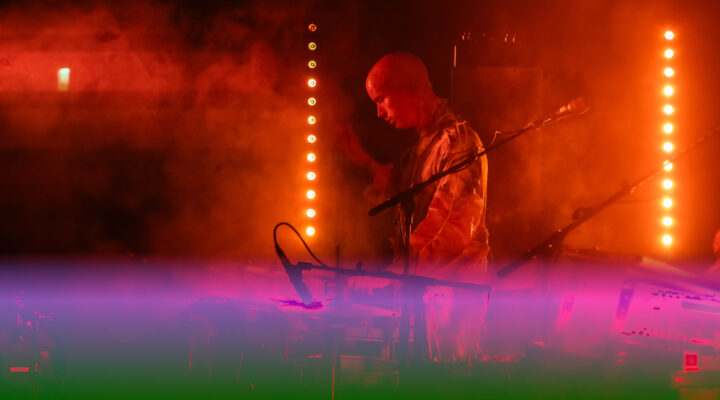
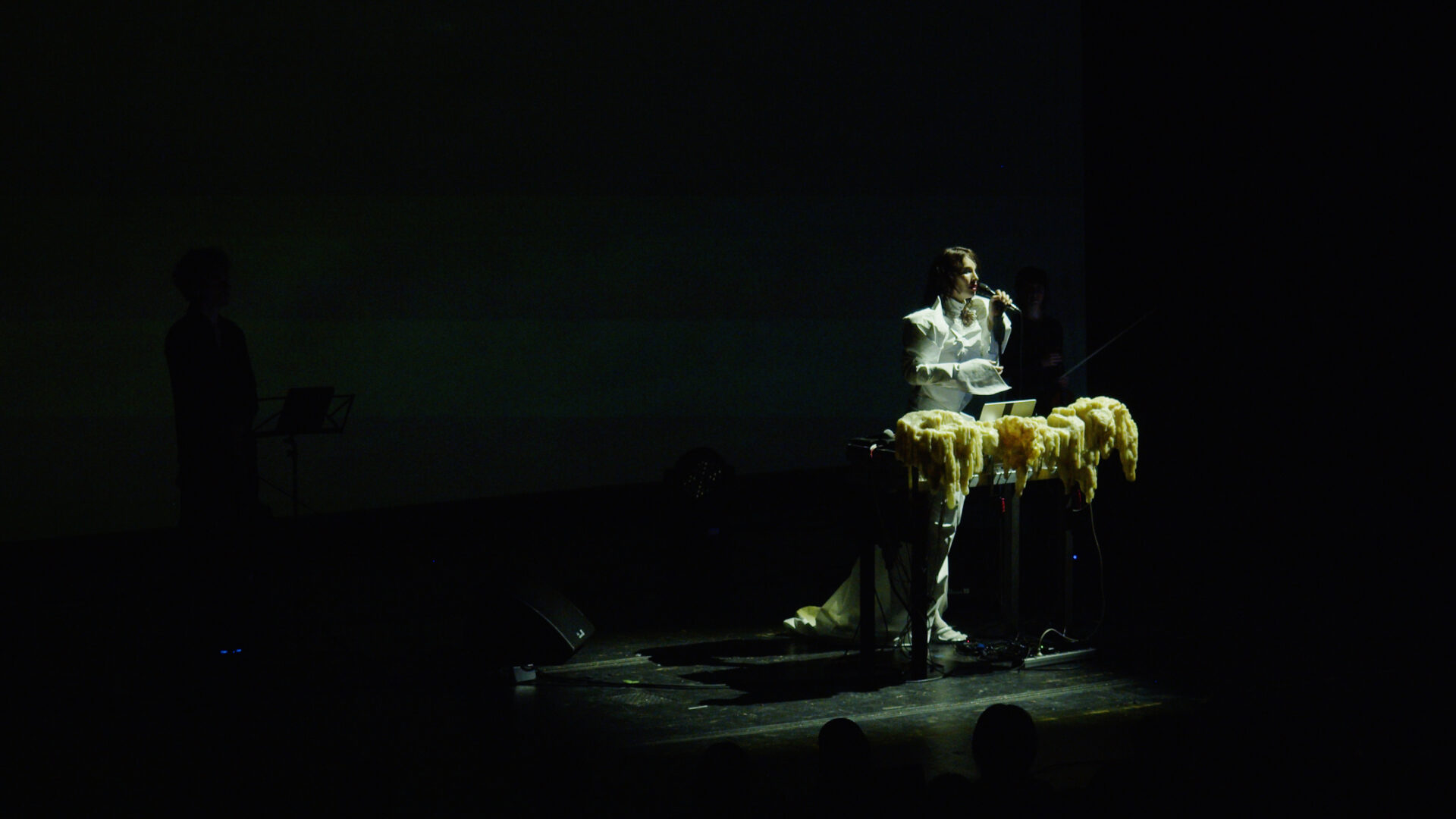
I understand that we’re all very chronically online, with a low attention span, so I was struggling a lot with that. The record is still very electronic, but I have the string players live. I did a show in Berlin with live spoken poetry and dancers joining me on stage, kind of entering a trance, so it felt more collaborative and performative. And there is a film. I thought, “What if I just let this be like an experimental cinema?”. The visuals are exquisite and really transporting, almost like you’re entering a novel or a fictional universe. It’s special. People can really leave behind their daily life for that hour. People have told me they were weeping during the show. It’s maybe not as interactive as Umm Kulthum‘s concerts, but I feel like I’m working up to that. I’ve been thinking a lot about how to make my work feel more interactive. I played a couple of shows this year where I was just on the floor with the audience, and I really liked that. Even that felt really different in a nice way.

What do you feel when you are performing? What are your interactions with the audience like?
When I perform, it’s very spiritual for me; I’m in my own world. But I can hold both realities at the same time, being in a private spiritual place but then also acknowledging the audience. This album, in particular, doesn’t leave a lot of room for stopping. It’s kind of relentless. That’s the whole point, you go into a trance. I want people to feel tired enough that they are forced to question things about their lives. It isn’t supposed to be easy. Everything is about smoothness and easiness in our world now. Everything doesn’t have to be easy.
There’s such a fear about tension and the tendency to avoid tension and any negative feelings. That’s also why music that can feel dreadful or chaotic is maybe more of a necessity right now.
Definitely. There’s so many issues that we have to face in our world right now. You have to be able to really deal with ugliness and difficulty. You don’t get good at solving ethical issues from just being safe all the time. If music is a vital societal infrastructure, then I think it should prepare us to be more engaged with the world. Especially if the world is ugly. So what would a music sound like that is vital infrastructure, for our lives? I don’t want to be comforted in a fake way. I want to be comforted in a way where I realize I had more in me than I thought I did. That is comforting to me, not the cheaper version of comfort. Anais Nin said: “Life shrinks or expands in proportion to your courage.” It is about building courage. This project in particular demands courage; it is hard to listen to the whole way through unless you are really fearless. But the last two tracks are like a really big hug. It’s like, “Oh my gosh, you made it through this, and here is your reward. You earned this.”
You’ve talked about this album as a response to crises, potentially as medicine for grief and sorrow. What other hopes and dreams do you have for music culture?
When we accept that music is more than a product, we will know intuitively what to do with it.
I find myself really bored and wanting more from music culture. Where are all the protest songs to rally us together? Who will take great songs and put them in a context where they have a social role? There are a million things that music could be doing that it’s not now doing. I don’t think it will happen through a capitalist music industry. In times when people really need protest music, it comes up. I am seeing beautiful videos of music teachers in Gaza, teaching children protest songs. I think we already know what we need. When we accept that music is more than a product, we will know intuitively what to do with it. It takes time to build a practice of something different. I don’t have all the answers but I’m engaged with the questions. This album isn’t meant to be a groundbreaking community infrastructure project; it is just an experiment I am making. That’s beautiful because it leads me down a path of long-term commitment rather than the need to immediately have everything figured out. Music is too sacred for me. I can only do what I feel called in my heart to do. I don’t want to twist myself to make money. I’d rather stay true to myself.
Lyra Pramuk performs at Muziekgebouw for the ninth edition of Fiber x The Rest is Noise on January 10th. More info on the event can be found here.
Related
Subbacultcha’s Guide to Gaudeamus Festival 2026
Newsa Festival for Curious Ears