Interview Interview by Sanae Oujjit
A conversation with Susu Laroche
Interview by Sanae Oujjit
Photography by Fraser Thorne and Susu Laroche
Leading up to Rewire Festival 2026, Subbacultcha spoke to Susu Laroche, a London based artist working between film and sound. In this conversation we talked about historical findings on notions of truth, music used in ritualistic practices, shadow selves and the endlessness of chaos.
Sanae: What or who is your art practice currently (sub)consciously in dialogue with?
Susu Laroche: At the moment it’s in dialogue with music used in ritual that has a repetitive quality to it, like Zār or the Sufi hadra, which is maybe like a constant background reference. I’ve gotten really into hardware recently and I’m looping many different elements at once creating this march into oblivion. The subconscious part of this world I’m building hasn’t really revealed itself yet. Sometimes I use glossolalia, which help create vocal patterns without words to avoid melodies dictated by language. Other times I open books, like Rumi, using it as lyrics on top of a soundscape to see what works rhythmically and fit with the imagery I already have in mind. But at the moment it’s purely sound.
S: When did you start working on your new project?
SL: In December. I became obsessed with recording really long improvised sessions where I’m layering drum machine, drones, strings, and voice on top of each other. I’m going through all that material now, but it’s very addictive. I can’t really stop making more because it’s just really fun. I’m currently reviewing the recordings and trying to see how they fit together, and then I want to start adding vocals.
S: Does presenting work help form that world—for example when making a record?
SL: Not really. When I’m working on something I prefer to be left alone to get on with it. I want it to be formed before sharing it with others. At this point I just need to immerse myself in recording and improvisation, but also in researching, looking at things, and seeing what sparks my imagination.
S: Do you know why you prefer to do that more in isolation?
SL: I think I just like going really deep into my head when I’m working. I try to sustain that place you reach when you feel like youre living in the work, staying in that obsessive place and refining the idea.
I try to sustain that place you reach when you spend a lot of time focused or in solitude.
S: Who, if anyone, are you speaking to when you perform?
SL: I think it’s a bit like speaking to the version of myself that existed when I made those songs.
S: So you’re very much in dialogue with your own inner world. I imagine that makes your work especially authentic, because it isn’t overly influenced by the outside.
SL: Yeah, I’m mostly using my imagination—going inside my head and asking: what can you build? What can you draw from? Where can you take things?
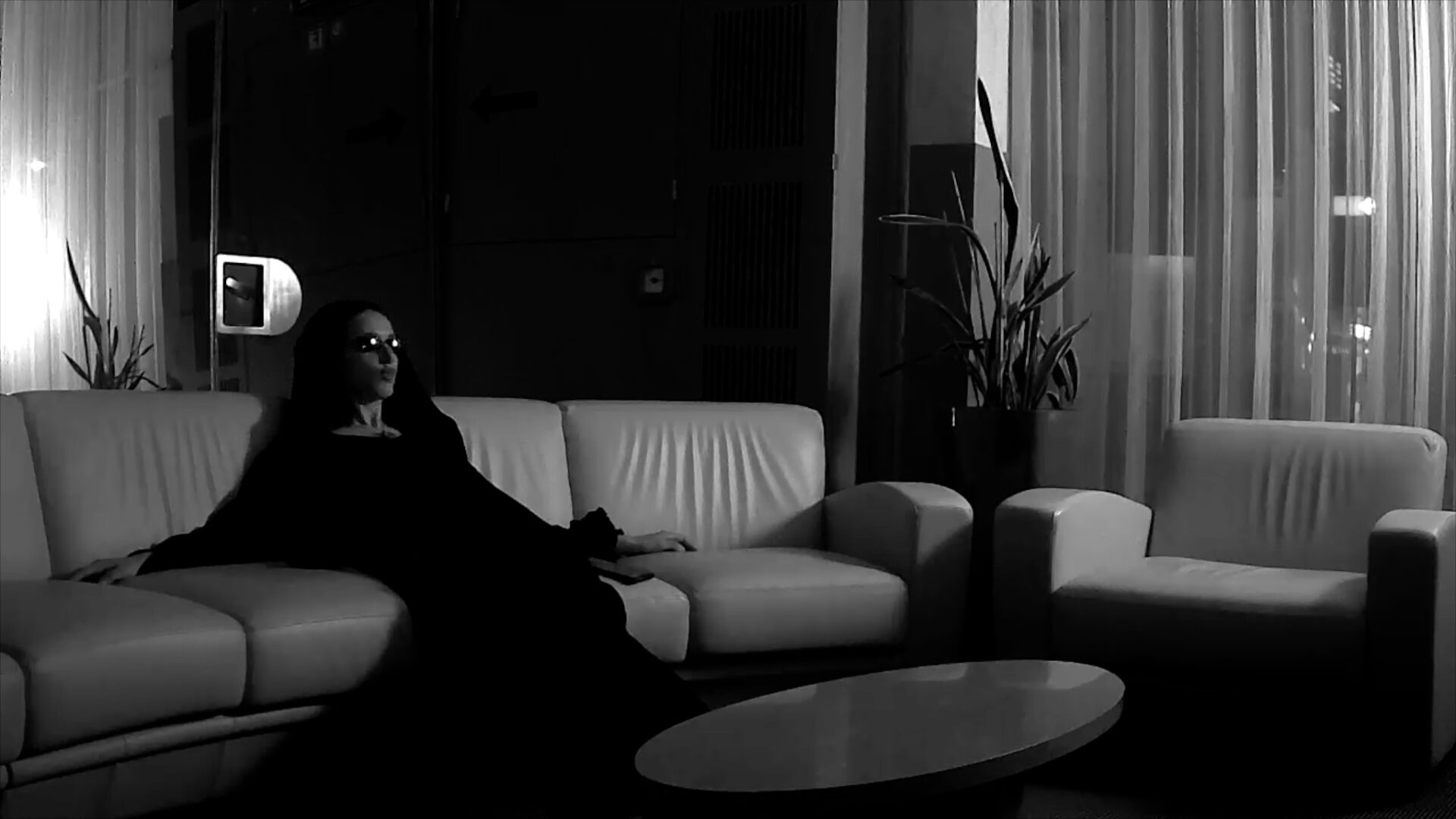
Image by Susu Laroche, courtesy of the artist.
S: What did you learn about yourself during the process of your last record? Were there any accidents that emerged through the gaps of repetitive sounds?
SL: When I made that project it was the first time I consciously thought: coming from a visual background, I should use those skills and bring everything together as a complete package. Doing that reminded me how much I enjoy making films. I hadn’t done it for a while, but when I returned to it, I was reminded why I love moving image. It also validated how important research, reading, and looking at things are to my practice. I’m always doing these parallel activities—making work while also absorbing whatever I’m interested in at the time. With that project it became more explicit. It felt like a concept album where all the research became a kind of puzzle I was assembling, and the music was communicating with that.
S: I read in the description of your last album that War Against the Lie is a para-fictional account of a historical law that governed ancient Zoroastrian civilisations in Persia. Could you elaborate on that?
SL: In Zoroastrian culture there’s the concept of the Lie–Druj—and cosmic truth—Asha. The Persian ruler Darius framed his reign as a war against the Lie. Anyone who opposed him was considered an agent of Druj, while he positioned himself as an instrument for restoring truth to the world. When I encountered that idea it resonated with the present moment. I started making the music in 2023 when the Gaza war began, and the concept of truth and lies felt very relevant. Today, truth is often presented as a lie, or vice versa. Condemning lies can be more politically useful than being truthful about what’s actually happening. I’ve been thinking about these different realities in tandem to each other—how the space between what we know is true, and what we are told is true, is getting larger and more depraved to behold.
Condemning lies can be more politically useful than being truthful about what’s actually happening.
S: When did you first come into contact with the concept of Iraqi and Kurdish prophets and saints?
SL: During lockdown I joke that I “radicalised” myself. There was a lot happening around Palestine, and people were becoming very vocal about it. I started reading a lot of history—books about Iran, Iraq, Afghanistan, and the wider region—trying to understand the roots of civilisation but also the roots of ongoing conflicts. At the same time I got into Sufism and began reading Rumi. I started using Rumi’s poetry for vocals. I also discovered figures like Rabia and Al-Hallaj. They’re somewhat underrepresented but fascinating. Many have parallels with other Western figures, for example, Al-Hallaj is quite Christ-like—he was executed for declaring “I am the Truth.”
S: It sounds like the war against truth has been a recurring phenomenon throughout history. Did your research help you understand our current times?
SL: I’m not sure it helped me understand—it’s quite distressing. Sometimes it feels like the West has a kind of destructive drive toward the origin, almost like a cultural matricide. When sacred places or UNESCO sites are bombed, when sites of early civilisation are erased, it can feel like an intentional erasure of history. And at the same time history is being rewritten in front of us. What I learned is that this has been happening for a very long time–humanities (or capitalisms) death drive at its most destructive is a hard pill to swallow.
S: It has rarely been about universal truth or peace; destruction and reign seem to be more attractive. It’s been an intense period globally.
SL: It really has. Sometimes it feels relentless. Since COVID there’s been one crisis after another.
S: I also noticed you made a record about the shadow figure Gebbeth from Earthsea. What drew you to that figure?
SL: I liked the idea of the shadow self being a figure of torment that follows you around. In the book it’s something you unleash and then have to confront. I sometimes relate to that in terms of the compulsion to create. It’s not a curse—I’m grateful for it—but it’s this constant presence. I always want to be making something. The Earthsea books are also something I revisit every few years.
S: Do you see that compulsion as something fruitful?
SL: Definitely… I’m grateful to be able to keep myself entertained. During COVID people were talking about taking time off, but I just wanted to work because I had so many ideas. Sometimes I wonder whether it’s connected to this capitalistic idea of work and productivity being the thing that validates you as a person, but for me it’s also just how I relax and keep myself entertained.
S: In your visual work you often use analogue film techniques—there seems to be an interest in the past. Is time travelling something you’ve always appreciated? And if so, why?
SL: I think about time as something non-linear. In your mind you can move across many time periods in a single moment. When you have access to the depth of history you can look at anything from any era. My use of film isn’t really about making things look old. It’s about the process. Shooting on 16mm or 35mm has an adventitious quality to it—you don’t know exactly how it will look until you see the result. There’s also a restraint: you only have a certain amount of film, so you have to trust yourself in composing the moment, capturing space.
The past has this whole breadth of history you can learn from, and as long as these things resonate with people, then they are clearly still relevant in some respect.
I’ve always been more interested in creating something timeless or unplaceable rather than something nostalgic. When you look at something, you might bring a set of associations and expectations and prejudices with you, which may actually make you a little bit blind to seeing what it is. I like that film is a very physical medium. There’s the image and there’s the form: how do they speak to each other? How do they compliment or counter each other? I’m not interested in the future, maybe because there’s not that much to look forward to. The past has this whole breadth of history you can learn from, and as long as these things resonate with people, then they are clearly still relevant in some respect. The concept of the Akashic records have this quality to it. I think about time and history in relation to that, everything all at once, endless parallel realities.
S: Shadows are a recurring theme in your work. What can we find in the shadows that the material world cannot reveal?
SL: The unexpected. Possibilities. When I’m creating, I’m trying to make something I haven’t felt or seen before. It’s important to remain open to the outcome being different from what you expected.
S: Is there an example of a track strongly influenced by doing research?
SL: On an older album called PARIDAIZA, I used protest chants from Egypt as the basis for the vocal patterns I was singing in Arabic.
S: Where do you practise a relationship with the spiritual in a city like London?
SL: Ideally in solitude. I have a few friends who share similar interests and we exchange things, and there is a lot going on here artistically, but I aspire to remain as hermetic as possible.
S: Is there an existential goal to your practice?
SL: Not really. It’s enough to move someone—to make them feel something. I also want to avoid being confined by external expectations about how things should be done. There’s no single way to live or to make work.
S: Your name is an anagram for “Chaos Lure Us.” What does chaos mean to you?
SL: Chaos, to me, means allowing yourself to be guided by intuition and the unconscious. Bringing fantasy into reality. There’s a divinatory element to making things. When you’re working and lose track of time—that state where you don’t remember exactly how something emerged—that’s where the real creative process happens. Afterwards you can refine it consciously, but the initial creation comes from this chaotic, trance-like place of pure action. Sometimes it feels like the initial exploratory impulse is a question you do not quite know the words of, and the work you make provides an answer to that.
S: Entering a subconscious realm where things are less linear.
SL: Exactly. There are no limitations there.
Susu Laroche will perform an A/V live show at Korzo on April 10th for Rewire Festival 2026. You can find more info on the rest of the program here.
Related
Minimal Music Festival: Bendik Giske & Sam Barker + Mohammad Reza Mortazavi
Music 18 April Muziekgebouw, Amsterdam